
OpenClaw Agent Architecture Explained | AI Agent Runtime System
OpenClaw Architecture Explained
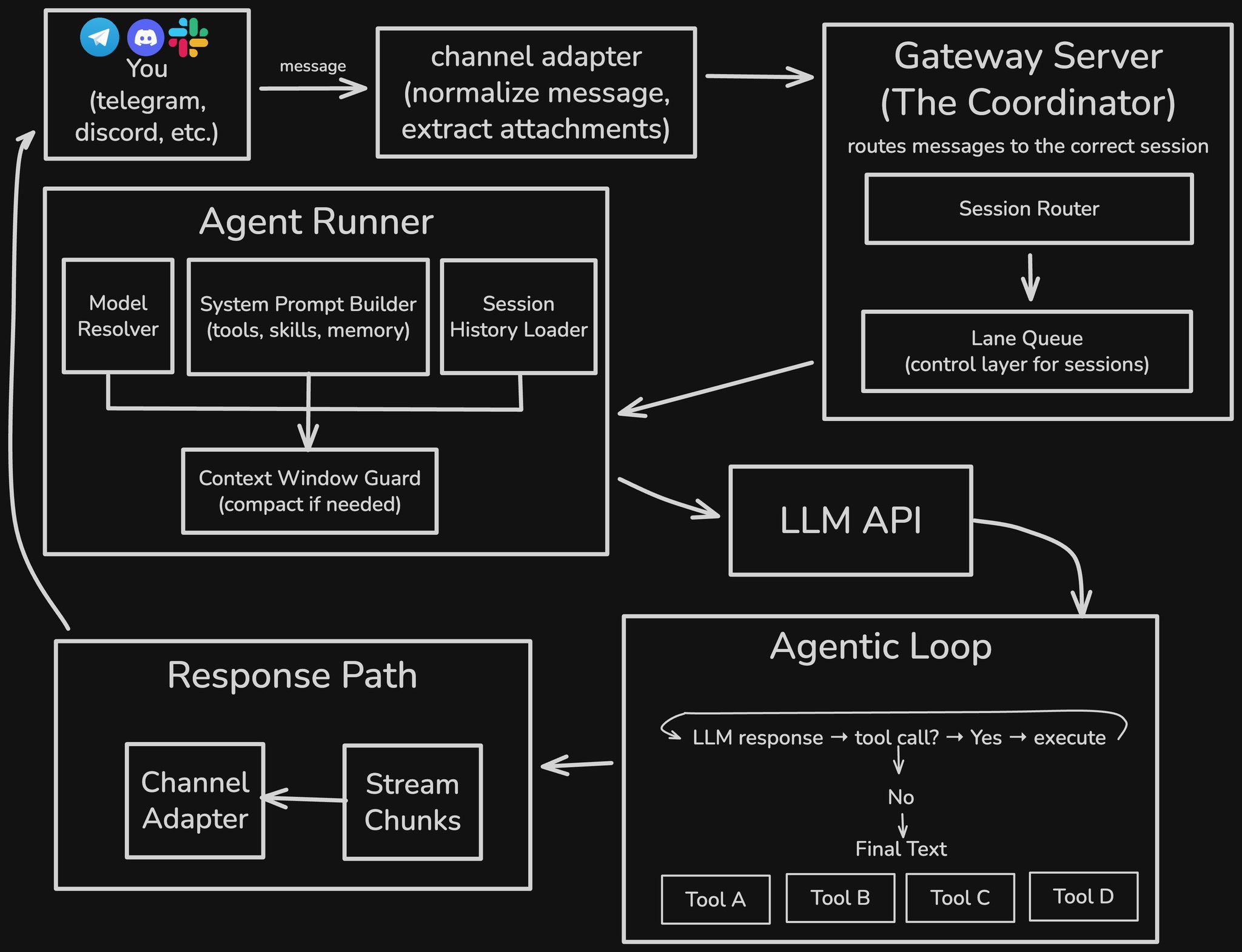
A Production-Ready Agent Execution Architecture
OpenClaw is not just a "wrapper library for calling LLMs"—it is a complete Agent runtime architecture.
As shown in the diagram, it clearly separates message ingestion, session scheduling, Agent execution, tool loops, and response output, with well-defined boundaries at each layer.
This article will analyze how OpenClaw works by following the actual message flow through the system.
1. Unified Message Entry: Channel Adapter
At the far left of the system is the user entry point, supporting multiple external channels such as Telegram, Discord, and others. Message models differ significantly across channels, including:
- Different text structures
- Different attachment representations
- Different event trigger mechanisms
To address this, OpenClaw introduces a Channel Adapter at the very front end. Its responsibilities are very clear:
- Normalize message formats
- Extract and unify attachment data
This layer does not involve any intelligent decision-making—it only performs protocol conversion and data cleansing. This design allows the system to continuously expand new message sources without affecting core logic.
2. Gateway and Session Scheduling: Gateway Server
After standardization, messages enter the Gateway Server, which serves as the coordination hub of the entire system.
1. Session Router
The Session Router determines:
- Which session the current message belongs to
- Whether a new session needs to be created
- Whether to continue an existing Agent state
In OpenClaw, "session" is the basic unit of Agent execution, not a one-time request.
2. Lane Queue (Session Control Layer)
The diagram specifically emphasizes the Lane Queue's positioning:
control layer for sessions
This means OpenClaw explicitly solves a key engineering problem:
How to ensure execution order and context safety for the same session in a concurrent environment.
Lane Queue's typical responsibilities include:
- Serial processing for the same session
- Preventing concurrent tool calls from causing state confusion
- Providing the foundation for rate limiting, prioritization, and isolation strategies
This layer is missing in many simple Agent implementations but is essential in production systems.
3. Agent Runner: The Real Agent Execution Environment
Agent Runner is the core execution entity of OpenClaw.
It is not "calling LLM once," but a runtime environment with context management, policy decision-making, and state control capabilities.
1. Model Resolver
Model Resolver is responsible for selecting the appropriate model, such as:
- Different models for different tasks
- Mixing high-cost and low-cost models
- Using different model strategies for tool decisions or text generation
This design enables OpenClaw to natively support multi-model systems.
2. System Prompt Builder
System Prompt Builder is the core shaper of Agent behavior.
As shown in the diagram, it dynamically integrates:
- tools (currently available tools)
- skills (Agent capability descriptions)
- memory (long-term or short-term memory)
This means the Prompt is not a static template but dynamically constructed as the execution state changes.
Agent capability boundaries, behavioral norms, and context constraints are all injected at this stage.
3. Session History Loader
This module is responsible for loading the current session's history, including:
- Historical conversations
- Already executed tool results
- Stateful context
This ensures Agent "continuity" rather than reasoning from scratch each time.
4. Context Window Guard
Context Window Guard's goal is to control context scale:
- Compress when tokens approach the limit
- Automatically summarize or trim historical content
- Ensure stable system operation
This is a typical engineering protection module, ensuring Agents don't fail due to context bloat during long conversations or long tasks.
4. LLM API: Decision Engine, Not the Endpoint
After Agent Runner assembles the context, it calls the LLM API.
But in OpenClaw's design, LLM output does not equal the final response—it enters the judgment logic of the next phase.
5. Agentic Loop: Action-Based Reasoning Cycle
The diagram's Agentic Loop clearly shows the Agent's core behavior pattern:
- LLM outputs results
- Determine whether tool calls are needed
- If needed, execute tools and return to the loop
- If not needed, generate final text
This loop embodies OpenClaw's core philosophy:
The value of an Agent lies in "deciding what to do next," not just "generating a sentence."
Tool call results re-enter Agent Runner, triggering a new round of decision-making until the task is complete.
6. Response Path: From Agent to User
When the Agent decides to output the final result, it enters the Response Path.
1. Stream Chunks
The system supports splitting responses into streaming data chunks:
- Reduce first-character response latency
- Improve long text experience
- Support real-time interaction feedback
2. Channel Adapter (Output Side)
Finally, the Channel Adapter converts the internal response structure into a format recognizable by the target platform and sends it to the user.
7. Overall Architecture Characteristics Summary
From the entire diagram, we can summarize several key architectural characteristics of OpenClaw:
Clear hierarchy, well-defined responsibilities
Message ingestion, session control, Agent execution, and model calls are completely decoupled.Session is the core execution unit
Agent state does not depend on a single request but is uniformly managed by Session.Agent is an execution entity, not a chat interface
Behavior is driven by a decision loop, with tool calls as a first-class capability.Clearly designed for production environments
Includes concurrency control, context protection, streaming output, and other engineering elements.
Conclusion
From an architectural perspective, what OpenClaw describes is not "how to use LLMs," but:
How to build a long-running, controllable, scalable Agent system.
In this system, LLM is one of the decision-making components, not the system itself.
The real complexity comes from the engineering governance of sessions, state, tools, and execution flow.